
Introduction
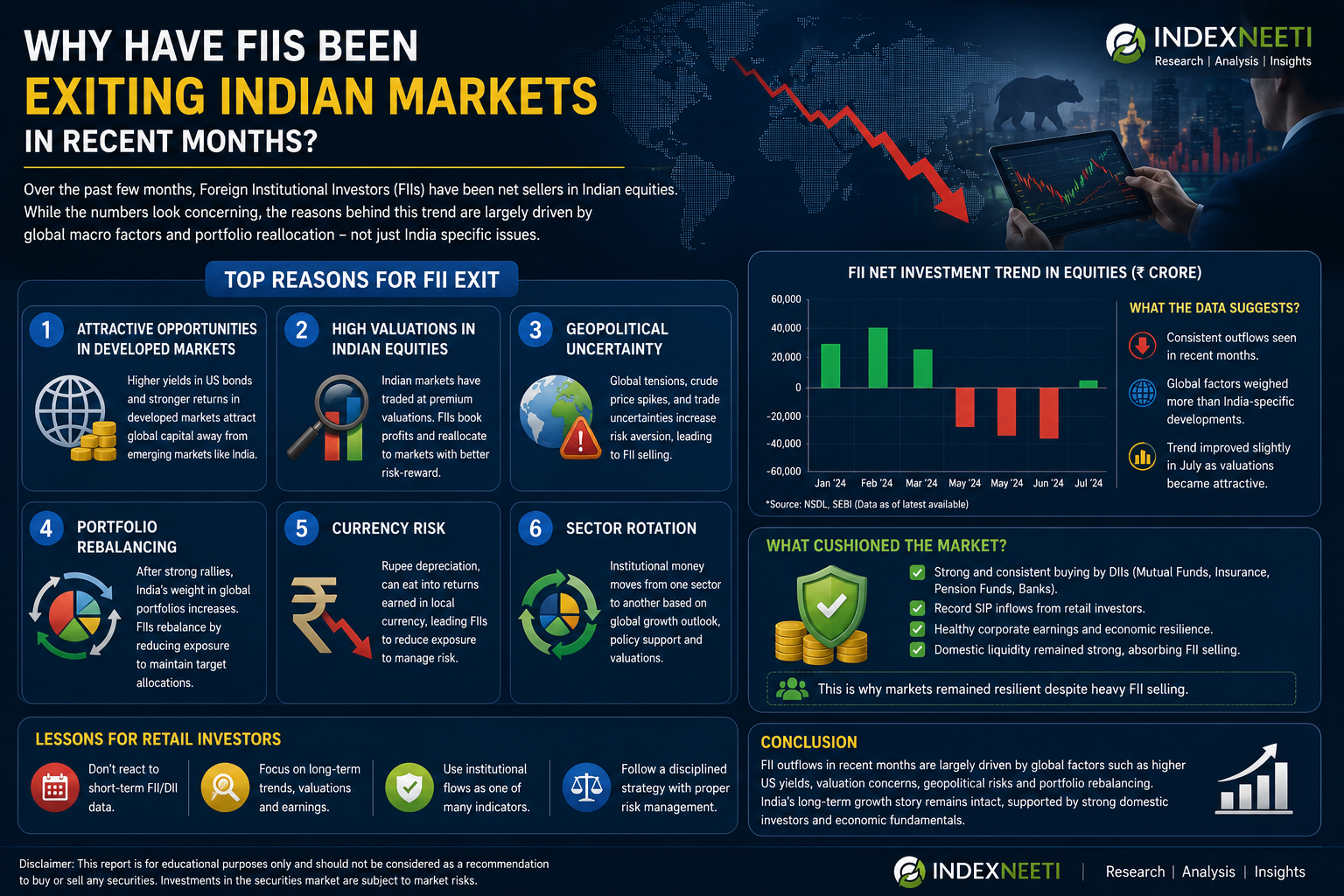
Over the past several months, Foreign Institutional Investors (FIIs) have reduced their exposure to Indian equities through sustained selling. While many retail investors interpret FII selling as a sign of weakness, institutional money flows are often driven by global macroeconomic factors rather than concerns about a single country’s economy.
Understanding why FIIs sell is more important than simply tracking the daily numbers.
1. Attractive Opportunities in Developed Markets
One of the primary reasons for FII outflows has been the availability of attractive investment opportunities in developed markets, particularly the United States.
When U.S. bond yields rise or global investors expect stronger returns from developed markets, international funds often rebalance their portfolios by reducing exposure to emerging markets such as India. This is a global asset allocation decision rather than a judgment on India’s long-term growth potential.
2. High Valuations in Indian Equities
Indian equity markets have traded at a premium valuation compared with many other emerging markets.
For large global funds, expensive valuations often reduce the margin of safety. When similar growth prospects are available elsewhere at lower valuations, portfolio managers may book profits in Indian equities and reallocate capital.
3. Geopolitical Uncertainty
Global events such as conflicts in the Middle East, rising crude oil prices, trade tensions, and political uncertainty have increased risk aversion among international investors.
During periods of uncertainty, FIIs generally reduce exposure to higher-risk assets and move toward defensive investments such as government bonds, gold, or developed-market equities.
4. Portfolio Rebalancing
Large institutional investors periodically rebalance their portfolios to maintain target allocations across countries and sectors.
Even if India’s economic outlook remains positive, FIIs may still sell Indian stocks simply because India’s weight in their global portfolios has increased after a strong market rally.
Portfolio rebalancing is a normal part of institutional investing and should not always be interpreted as a bearish signal.
5. Currency Risk
Foreign investors earn returns in their home currency.
If there is concern that the Indian Rupee may weaken against the U.S. Dollar, part of their investment gains can be offset by currency depreciation. This currency risk sometimes encourages FIIs to reduce equity exposure.
6. Sector Rotation
Institutional investors rarely sell every sector equally.
Instead, they often rotate capital between sectors depending on global economic expectations. During recent months, investors have reduced exposure to some sectors while increasing investments in others such as financials when valuations and policy support improved.
Why Didn’t the Indian Market Collapse?
Despite substantial foreign selling, Indian equities remained relatively resilient.
The primary reason was strong buying by Domestic Institutional Investors (DIIs), including mutual funds, insurance companies, and pension funds. Regular SIP inflows from retail investors also provided consistent liquidity, helping absorb a large portion of FII selling pressure.
What Should Retail Investors Learn?
Retail investors should avoid making investment decisions based solely on daily FII or DII activity.
Institutional flows represent only one part of the overall market picture. Before making any trading or investment decision, investors should also evaluate:
- Technical market structure
- Corporate earnings
- Economic indicators
- Valuations
- Risk management
- Market sentiment
A disciplined investment process is generally more effective than reacting to short-term institutional buying or selling.
Conclusion
FII selling over recent months has largely reflected global portfolio allocation, valuation concerns, geopolitical uncertainty, and changing risk preferences rather than a loss of confidence in India’s long-term growth story.
Institutional money flows should be interpreted within the broader macroeconomic context. For traders and investors, understanding the reasons behind these flows is far more valuable than focusing on daily inflow or outflow figures alone.